Archive for the 'Editing' Category

29
Dec
11

What a note to end the year on!

I’ve just received a copy of the latest review for Meditation for Two…..I can hardly believe that it is as glowing as the previous one.  I had to post it and offer my thanks to Mary Daniels for her thoughtful, generous remarks. It’s going to be published in the February Issue of Dressage Today, available January 2, and on DressageToday.com.   Dressage Today????  How cool is that for an equine photographer/writer? Pinch me. Again.  (You can have your very own copy by clicking on the tab above!)

The review:

by Mary Daniels

As the title might offer a clue, this is not a how-to book about how to train horses, but one about a very personal and unique philosophy—“Because the nature of the horse demands it, this is a mystical, metaphysical book,” says Barbier. He writes about “allowing our thoughts to be happy ones, finding our smile and learning to use it through discipline, meditation, visualization and love.

“This book is a reflection about the love of horses and how much they care and want us to be better. It is my belief that were we to allow ourselves to listen, were we to allow them to speak, they would surely have offered such a book to us.”

I agree with what Psillas says in her introduction to this book. That “we ride as we are,” which is true, and “what better purpose for a life than to hold the space for beauty.” To me, horses are a thing of beauty. A joy forever as a great poet once said, and beauty is medicine.

Perhaps I am not mystically inclined enough to understand all of the text, such as the preceding idea that were they allowed to speak horses would offer such a book to us. The ones I know might just ask for a charge card to the nearest greengrocer, or a romp in the hayfield. It may be one must belong to the Inner Circle of this following to be able to absorb the more esoteric aspects of this philosophy.

But there were parts I liked very much and here are a few from Barbier: “Horses and humans: the idea of separation first and then a coming together when mutual respect and understanding are attained is too simplistic, though not to be ignored. Rather, if I can say, it is the sense of oneness first, and then how to remain in that oneness that I believe is the essence of successful and symbiotic interaction between human and horse.

“The horse must trust the student. He must accept and enjoy a comfortable position, something that does not always come naturally. In turn, the student must trust the horse, both physically and mentally. If your riding mentality is based in fear, the horse cannot believe, understand or feel comfortable with you. Panic and evasions follow. A void in the student creates a void in the horse. Horses are the mirror of your soul.”

“The attitude that we are the only or best conduit of energy is a limiting one. The horse is already here.  We must learn to be here. Our undisciplined minds and our egos cause us to live in the past or in the future and we must remind ourselves constantly of the goal of self-realization. Unlike the horse, we are so busy doing, we forget simply to be, we are so busy working, we forget to enjoy. Horses demand our presence, and this mental discipline in turn allows communication and oneness to happen. They teach us to be in and stay in the present, to share the same vibrations, the same space, the same energy. They teach us to replace organized unhappiness, unfulfilled dreams and expectation with the attachment and appreciation of the very moment. When acceptance and grace flow between horse and rider, the centaur can exist.

“An undisciplined mind is like a young green horse—full of life, scattered and uncensored. All manner of achievement is possible when the horse, like your mind, comes to the calm knowledge of self and respect of others. Together these notions bring harmony and joy. Gratitude and reverence allow us to be and feel that there is nothing we cannot do. Remember then, to say thank you. The open mind and the readiness for the path to further enlightenment will create real-life miracles.”

And my favorite: “I consider the shoulder-in the miracle movement. But I prefer to call it shoulders-in. The outside shoulder must be included in the movement, in our feeling of the movement. From the daily work for the original work-in-hand around one pillar, a technique centuries old, we need to understand why this is such a revealing movement, why it is such a powerful tool. The simplest answer is that it gives the horse a feeling of togetherness, then of independence. He learns where his legs and his body are in relation to himself and to the rider. This knowledge offers security to him and in turn, imparts an additional, undeniable mental strength, as any successful human athlete can attest,” he writes.

That said about the text, one must remark that the accompanying photos are lovely. Many of the subjects are of the Portuguese Lusitano breed, one of the world’s most striking and handsome. But there are also photographs of natural and man-made wonders, from the floral to the architectural, which make you pause and reflect.

The design of the book, by Psillas, is elegant and pleasing to the eye. “The display type of this edition of Meditation for Two is Cezanne with a nod to Dominique’s French heritage and to link and respect the arts of handwriting, photography and bookmaking, as well as the influence of the painting Masters on the history of photography,” she writes. The Old World sensibility in its creation makes this book a keepsake, a gift book bound to be appreciated by the receiver.


15
Dec
11

the importance of a message

I had such a wonderful surprise yesterday when I opened an email message from my publisher. She wrote to tell me about a great review in an important online journal for my book, Meditation For Two.  Happy as I was to read such nice comments, I realized that this was much more than a book review.

The words written by Cindy Foley were an affirmation on so many levels. First, people are searching for a deeper, more meaningful relationship with their horses. Dominique eloquently speaks to this throughout the book, and in the life he has led for the last forty years. Second, the power of the written word to reach people is magnified when you hold a book in your hands and immerse yourself in it. And third, the photographic image, when made with love and layered thoughtfully into an essay, can facilitate and amplify the connection. In Dominique’s words, it can “…create a greater molecular change”.

Cindy “got it”. I am grateful that an even greater number of readers will have the opportunity to experience the transformative nature of the book because of her generous review.  The most important thing about the book is its message; not the photographs, or design, though I am happy to have created them; not the number of books sold (though greater numbers would be super).

From the review: “The photos are misty, blurred…chosen because they speak without the need for a caption. They’re soulful, matching the words.”

If you are a photographer, consider your message. Work to find ways to incorporate your images with thought-provoking texts. I’m happy that Cindy understood why my photographs lacked captions in the book. I work hard to create images that speak by themselves or rest easily but meaningfully alongside a considered text. I believe it has made me a better photographer.

Thank you for finding and reading the blog.  Click HERE to see the entire review on Horse Journal.  You can order Meditation For Two directly from me by clicking HERE.

One last ‘message’…..my life works because I am surrounded by loving, kind people on every side. I have to take a moment and say thank you to Debra, Lisa, Chaya, and Alea for taking such wonderful care of my horse. Fol Amour is 29 now but thinks he is 5, still a stallion (and knows it), but has a good life because he is worked and cared for daily. I am on and off planes and zipping across continents, but my heart is at ease because I know he’s right where he should be. Here’s a picture of Chaya with her boy, Winston, taken just yesterday at Barbier Farms in Healdsburg, California.  Thank you, Chaya!

15
Oct
11

“…the rhythm comes back” ~ Bruce Davidson

The Widow of Montmarte, Mme Fauche ©Bruce Davidson/Magnum Photos

Wow. Sometimes the synchronicity of existence stuns me. This morning I was reading my favorite photography blog (Lens, NYTimes) and the words of Bruce Davidson jumped off the page. While speaking of making a group of photographs nearly forty years ago, he said  ”What’s great about looking at your work is the emotion comes back. The emotion comes back. The rhythm of what you were photographing comes back. It’s almost like a musical score.”

I had just come in from photographing the actual harvest of the grapes and was considering an edit to yesterday’s post on rhythm. Before I jumped into the edit I decided to stop and breathe a bit and open up the NYTimes Lens blog. There it was, my thought and emotion, my INTENT reflected in Mr. Davidson’s words. To celebrate the publishing of his retrospective, (“Outside Inside,” a three-volume, boxed set — published by the master printer Gerhard Steidl.) James Estrin and Josh Haner conducted this deeply thoughtful interview at Mr. Davidson’s home.

There is no way I could/would ever compare my work to Bruce Davidson’s, but I recognize the similarity in how we work and how we feel about what we do. This is incredibly affirming to me. I’ve always been grateful for the artistry and humanity of his work, now I feel just a little closer to it. Thank you, Bruce Davidson, for the images, your humility, and your thought.

Click here to read the entire interview and see a bit of his stunning imagery. http://lens.blogs.nytimes.com/2010/06/28/showcase-177/ It is a bounteous harvest.

Outside Inside, ©Bruce Davidson, 2011

27
Aug
11

A few more thoughts about Sam Abell’s workshop

If we are lucky, we get to experience an event that stays with us and molds us for the rest of our lives. I have had many blessings of this nature, but this last week reminded me of the importance of that initial experience.

In the late fall of 2005, I had the good fortune to take a workshop with Sam Abell on the mid-coast of Maine. The first night of the class offered us the opportunity to hear a lecture by Sam titled “The Photographic Life”. Sam’s sonorous story-telling style had the audience rapt, but I was struck by the deep humanity in the images as well as the personal stories of a life well-lived. Since that week I have worked hard to embody Sam’s advice of making the best picture in any situation and I have been helped by the voice that I hear while composing. It comes in from over my right shoulder and says things like this: check your edges; are the elements separated?; do they exist in their own world?; is it involving?; are there layers in the image?; setting, expression, gesture.

I’ve been assisting Sam in classes and with lectures for more than five years now. This past week I encouraged a number of good friends from all over the country to come to Whidbey Island for at least the lecture, if not the entire class. A number of (very intelligent) people took me up on the invitation. I heard from them the exact remarks that I made six years ago: It was wonderful; The sensitivity and depth of emotion in the images and the stories is deeply moving; it gives us a totally new way to see images and to think about our own photography.

Thankfully there are many wonderful teachers and mentors in the world. I’ve had several in different areas of my life. I suppose what I want to say with this blog post is this: Find a mentor or teacher whose vision and life you respect and emulate them. Make your own path, but hold on to the tenets they have lived by and see where it will lead you. The photographic life is just one life among millions of choices, but as Sam said, “it is the right life for me”. Building layers of depth and breadth in my life as well as my photographs has brought me to a place of deep appreciation and offered many moments of joy.

This state of being is open to us all but if you want to ignite a fire, take a Sam Abell course or at least experience a lecture he’s offering. Next up: Sam will be appearing at the INVision Photo Festival in Bethlehem, PA ( http://www.artsquest.org/invision/ ) Prior to that he is teaching at the Santa Fe Workshops in early October. Maybe I’ll see you there.

Here’s a gallery of images I’ve made over the years on Whidbey Island and around Seattle. I vow each year during the class to spend more time photographing…this time I made it happen.  You can too.

23
Aug
11

Sam Abell Interview

First Drafts: How Sam Abell Makes a Photograph, Alex Hoyt and Ross McDermott

I’m busy finishing the book layout that was created in our week-long workshop at the Pacific Northwest Art School in Coupeville, Washington.  The layered life on Whidbey Island, as it is everywhere, became the backdrop for Sam to teach his method of photography, one of layers, of “compose and wait” and one of still life scenes that have a life or incorporate life. This interview encapsulates that teaching in a marvelous 10 minutes of a deeply considered philosophy and lifelong process of making photographs. Take the time to view it and you’ll have the outline of  our workshop and a sense of the meticulous care that Sam takes to create Life in a Still Life.

Next post:more thoughts and favorites images from Coupeville over the years of (gratefully) assisting Sam.

15
Mar
11

Middleton Place, a national treasure

It’s been a very busy time, and one marked by illness as well, so the blog has been neglected. Sorely. Here are images from a working trip to Florida, with a stop at one of my favorite gardens in South Carolina: Middleton Place. Prior to leaving West Virginia (it was a road trip) I checked the weather and the forecast promised fog!  Driving in to Walterboro near midnight I encountered HEAVY fog.  I was so excited I could barely sleep. But I was up at five the next morning for the drive on in to Middleton Place and a few happy hours of shooting ensued.  If you are interested in history, in gardening history, or simply enjoy tranquility and a gentle, restful landscape (though with a hint of Southern moss-draped mystery), I urge you to visit this jewel in the Carolina low country. http://www.middletonplace.org/ All but the last of the photographs below made with the kind permission of Middleton Place.

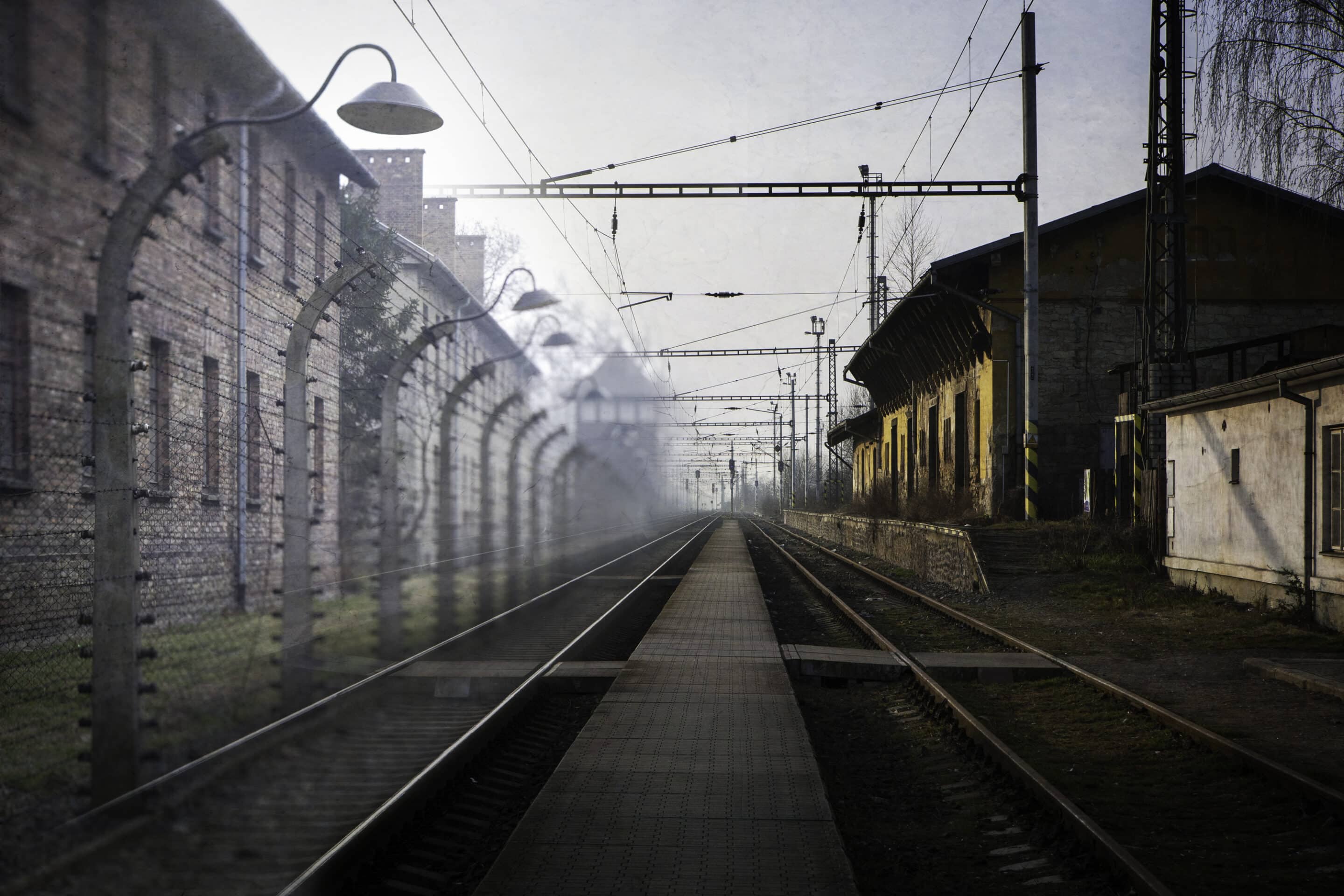
Of course the fog and atmosphere had me thinking about layers and textures. Some of the images I prefer ‘straight’, while others I enjoyed layering with my favorite Fly Paper Textures. What stays with me though is the experience of having been there and walked in the vague, vaporous layers of history, place, and moment.

The last photograph is a challenge.  Which of my readers can identify the scene in the last image?  Thousands of people have seen it in photographic form, hundreds certainly have studied it.  I just happened upon it on a Sunday morning when some strange otherworldly force twisted my head hard to the left and BAM! So here’s the hint: I jumped out of the car to make the image but had no time to wait.

14
Feb
11

Spring on my mind

Generally, I prefer to stay “in the moment”. But looking through my photos and finding this wild plum branch in full bloom has me looking ahead to spring. Yes, I have textured the image (with two of my favorite textures from Fly Paper…hint….see button at right!) but very lightly. Most of the softness and mottling in the image comes from a very shallow depth of field and a pretty strong backlight.  So think sunshine, warmth, and softness. Make the sun your friend, break some rules and shoot into it!

01
Feb
11

Push My Button!

I have a “button” on my blog.  It’s a first.  It’s big. I’m excited.  (Ok, maybe it’s not really big, but it feels big to me.)  The fine folks at Fly Paper Textures have asked me to pop on their link from my site.  I agreed readily and presto, there it is. Look over on the links side and you’ll see the cool textured image with the blueberries.  I’m enjoying the easy back and forth, the quid pro quo, that the internet allows.  Fly Paper Textures has been sending readers to my blog every single day since late November.  I’m delighted to be associated with them, and in turn, send them potential texturing newbies or old hands looking for new textures.  So, push my button, please!

Here’s a new image, textured, from a local landscape that I know very very well.  My goal was to create a universal image that had the feeling of a solitary journey. The little rise and bend to the left (with the tree doing the same) suggests that we don’t know what might be ahead, where each turn will lead.

Late afternoon in winter, Antietam National Battlefield, Sharpsburg, Maryland

The recipe was simple, the finishing was one of nuance. I used two textures, in overlay mode at different opacities, but then masked out some of the effect in certain areas.  I smoothed out the texture on the road a little bit and blocked out some of the darkening of the tree to bring out the ochre tones and keep the detail. This image works well cropped square or cropped in vertical format with the tree being the focal point. When making images these days I try to remember to frame them, or take alternate images, so that they can work in any format and lend themselves for stock sales. In six months or so I’ll let you know how successful my thinking is.

In the end the feeling that remains and is “enough” is the feeling of satisfaction. I saw the scene, I felt the potential, and I made the image. I am grateful.

29
Jan
11

“We see things not as they are. We see things as we are.” — Anais Nin

I am often thinking about this premise. Whether it’s a question of a family dynamic, a discussion with a collaborator, or simply reading a news item, I find myself wondering what filter I am placing on a discussion or opinion.  But lately, photographically, I’ve been working at seeing things NOT as they are.  I want to see what they could be.  I want to visualize how an image could evolve. I want to be able to see the geometrics and dimensionality of a scene and take that and layer upon it a different reality.  This is what I perceive could happen if I were a painter.  I am not a painter, but I am really enjoying the ability to use a different technology to effect a painterly image. By creating something that was suggested by a three dimensional scene and translating that into a purely personal vision, I think I am truly photographing, and seeing, as I am.

Here is my workflow for an image I made on Wednesday evening at the height of  a snowstorm:

The atmospherics of the scene are important in this image. The white vertical lines are not blown out highlights, it is snow plastered on the northwest side of the tree trunk. The image was fully focused, but the foggy nature is the blizzard effect of the heavy snowfall. I made the photograph about 5 pm with just enough light left to reveal the light and dark patterning. Image capture  with swipe technique as a raw file (1DS Mk3, 24-70 2.8L, f22, 1 second exposure, ISO 160, 1.5+ stops exposure compensation (usually needed when photographing snow), then into Lightroom 3 to adjust exposure ( a touch lighter, with a bit of added contrast from default 25% to 31%), then crop to panoramic.  The top was cropped out as the bottom of the photo is most important to me.  I was keenly aware of the far right grouping while photographing, to be sure the transition from the tree trunks into the ground was smooth, and to be certain I had separation between all the tree trunks as they dance along the back layer of the photo.

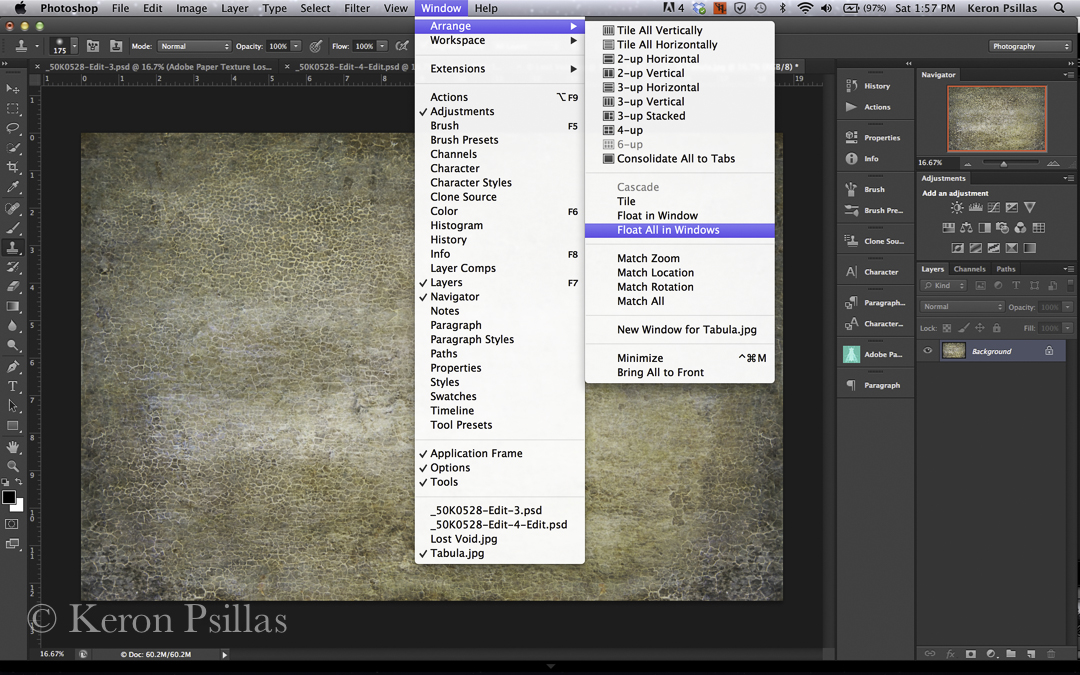
Choose Edit photo in photoshop from Lightroom (Edit a copy) to add layers of texture.  I chose two textures from FlyPaper Textures to add dreaminess and a hint of color to a black and white scene.

What you see above is the original file, out of Lightroom, cropped.  Next I opened the two Flypaper Textures, Serafina Sky and Europium from Lightroom (Edit a copy in Photoshop).


When I opened Serafina Sky I needed to rotate the image 180 degrees, so the clouds would be in the top of my image.  I was after a mistier look than what was in the original capture. Further, I wanted the slight blue-ish tone to add a bit of dreaminess to the straight black and white capture.  So I put the image on top of the original as a separate layer in Photoshop CS4. I changed the blending mode to Overlay and dialed the opacity back to suit me.  Then I added Europium in the same manner (separate layer, blending mode on overlay, then dial in the opacity to suit). With the Europium layer I was looking for a bit of the vignette effect and the added textures.

You will notice that the textures are SQUARE images and my image is a panoramic format.  When you lay your texture over your image, choose EDIT>Transform>Scale and drag your sides to conform to the shape of your image.  When you are satisfied (and you can move it around in the image with the move tool too) you hit the checkmark to okay the transformation and then go to your layer and work with your blending mode and opacity.


The image above is the initial image with Serafina Sky overlaid.  I pulled the opacity back to 53% and then I used an HSL layer to take the cyan to a more purple-y blue. Just slightly.  The key with each of these decisions is subtlety.  Then, to add the mistier look  (image below) I overlaid the Europium layer.  I pulled the opacity to 74%. The Europium texture is one of my favorites for adding slight vignetting and mystery.  It interacts with colors nicely and adds a touch of color in neutral images.  This is my final image.

As I mentioned above, I believe that subtlety is the key in working with this type of processing. I want the viewer to become involved with the photograph, not to say “WOW…that’s intense processing”.  I’d like my photographs to reveal a little about me, or even deepen the mystery.  As always, comments welcome and deeply appreciated.  For now, the forecast is for more snow on Tuesday.  Can’t wait!  And once again, my gratitude to Freeman Patterson and Tony Sweet for the inspiration, for lighting the path and to Fly Paper Textures for such a great product. They are tops to deal with and generous with their expertise.


26
Nov
10

21 states of mind

Here’s a long list of numbers to contemplate: 4925 (miles), 182 (gallons of gas), 21 (states), 6 (liters of Iced Tea), 4 (lemons), 1 (world’s largest cross…of this I am dubious), 1,000,000 (pictures seen and not taken).

A couple of posts ago I commented on the journey I was about to undertake and my feeling of sadness for the images I wouldn’t be able to make. The experience was far more frustrating than I imagined. So instead of simply looking for images I couldn’t make, I started to try to feel the culture and the state of mind for each state I was passing through.

Reading the billboards proclaiming “The Land of Enchantment”, “Find Yourself Here”, and “It’s Like a Whole Other Country”, gave me the first impression of uncharted territory. Then I began to notice the structures, new and old, the way we have imprinted our values on the land by erecting modest farmsteads or garish strip malls. I noticed what the states were most proud of….”Home of Garth Brooks”….”Home of Tyler Hicks”…and then I began to see evidence of history and warnings of the future. The dust bowl of the 1930′s was not hard to imagine in the panhandles of Texas and Oklahoma, and all down I-5 South in California there were proclamations of a current dust bowl, created by Congress and Diane Feinstein apparently. The sign for The Chisolm Trail created images of calling cattle and weathered cowhands with dust-encrusted faces, but I was met with asphalt, a decrepit gas station, and a deep-fried menu.

Yet underlying all of these images was an eternal dynamic landscape. Altitude changes brought different vegetation and geology. The wind and water have created patterns in the land as well as patterns of habitation. The stark surreal beauty of hoodoos gave way to gently sloping hills and meadows with aging cottonwoods in the washes. Wide rivers with flood plains are still flanked by cotton fields….so many spindly dry stalks with puffy white marshmallow tops. Red clay roads are cloaked in kudzu and draping moss, the stars in the night sky and the moonlight through the pines (Thank you Ray Charles) the only relief from growing claustrophobia.

Our interaction with this earth, our home, reveals so much about us. Rolling across 21 states in four days has left my mind spinning….and working to find ways to return to each of them and discover the Enchantment, the Smiling Faces, and The South’s Warmest Welcome. I can’t wait to photograph as I am in these places.

Here’s a selection of photos from my phone, using a couple of applications from Best Camera and Hipstamatic. Fun.


my website...galleries, other writing,

Flypaper Textures

Flypaper Textures


February 2012
M T W T F S S
« Dec    
 12345
6789101112
13141516171819
20212223242526
272829  

Visitors

News on the go


Follow

Get every new post delivered to your Inbox.